The nights have turned. The heating's back on. And a few of you have opened a tin to find little grains and crystals sitting in the balm that weren't there before.
Nothing has gone wrong. Nothing has gone off. What you are looking at is shea butter and cocoa butter doing precisely what real plant butters do when the temperature drops. They crystallise.
In June we wrote about the opposite problem — your balm going soft, even liquid, in a heatwave. This is the same story from the other end of the thermometer. And it ends the same way. A balm that responds to the weather is a balm with nothing synthetic holding it still.
"There are little grains and crystals in my balm — is that normal?"

Yes. Completely normal, and more likely the colder it gets.
It turns up in a few forms, and every one of them is the same thing happening:
- Fine crystals spread evenly through the tin
- Small hard lumps sitting in otherwise soft balm
- A crystalline layer across the top, sometimes paler than the balm beneath
- A duller surface where it used to look glossy
Rub any of it between your fingers for a few seconds and it vanishes. That is the tell. Crystals that melt away under gentle warmth and pressure are fat crystals. They are not mould, not separation, not a batch gone wrong.
CRYSTALLISATION
Cold hardens the butters into crystals. Warm it, rub it in — back to normal.
Which of our products do this, and why
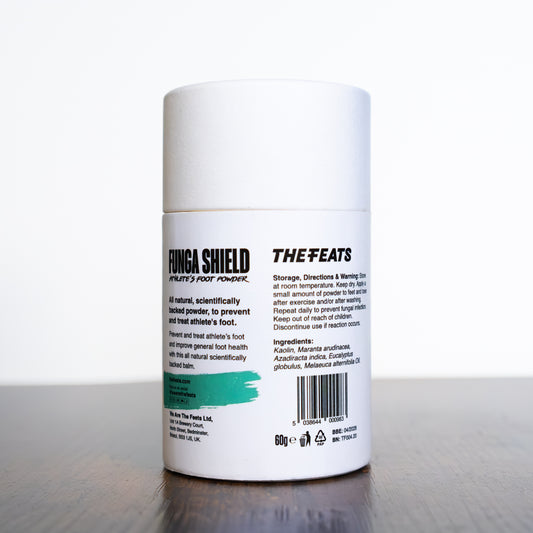
Three of the four. The one that doesn't is the powder, because there is no fat in it to crystallise.
| Product | Why it can go grainy |
|---|---|
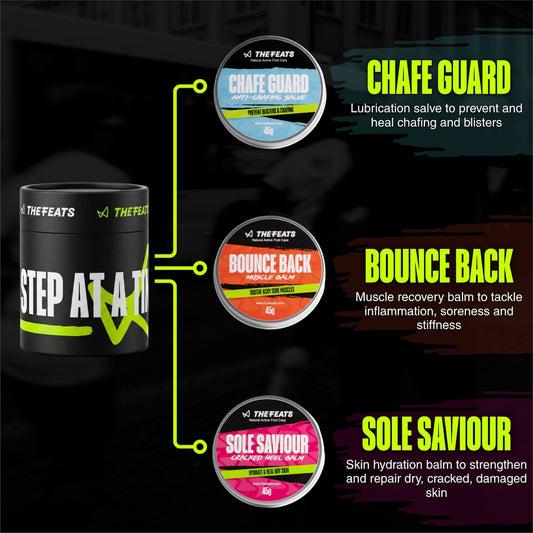
| Sole Saviour | Shea butter and coconut oil, held in beeswax. Shea is the most crystal-prone butter we use, so this is the tin you are most likely to notice it in. |
| Bounce Back | Coconut oil and shea butter carrying the turmeric, willow bark, ginger and lavender infusion. Same shea, same behaviour. |
| Chafe Guard | Coconut oil and cocoa butter in beeswax. Cocoa butter is the classic blooming fat — it is literally the fat in chocolate. |
| Funga Shield | It won't. Kaolin, arrowroot, neem, eucalyptus and tea tree — a dry powder with nothing to crystallise. |
There is no additive in any of those tins whose job is to stop this happening. That is not an oversight. It is the entire point.
Your balm works exactly as well as it did in June
This is the bit that matters, so we'll be blunt about it.
Crystallisation is a physical change, not a chemical one. The fat molecules have rearranged how they stack. Not one of them has broken down, oxidised, evaporated or reacted with anything. Nothing has left the tin.
Which means every active is still there, at the same dose it was on the day it was filled:
- The triterpenes and cinnamic acid in the shea, and the propolis, in Sole Saviour
- The curcumin, salicin, gingerols and linalool in the turmeric, willow bark, ginger and lavender infusion in Bounce Back
- The methyl salicylate from the wintergreen and the cocoa butter film in Chafe Guard
And the crystals don't survive contact with you. Skin sits at around 32–34°C, and rubbing adds friction heat on top. That is comfortably enough to melt the fat crystals straight back down as you apply it. By the time the balm is on your heel, it is molecularly identical to the balm you applied in August.
Different texture in the tin. Same balm on your skin. Same job done.
How to get the smooth texture back
The twenty-second fix. Scoop what you need and work it between your fingertips for ten to twenty seconds. Body heat and friction melt the crystals. Apply as normal. Honestly, this is all most people need to do.
The whole-tin fix. Sit the closed tin somewhere warm for an hour — a bowl of warm water, an airing cupboard, a room that has had the heating on. Not on a radiator, not in a microwave, not in boiling water. Overheating the balm will drive off the volatile essential oils that do half the work, and that is the one thing here that genuinely costs you performance.
If you do fully melt it, cool it fast. Slow cooling is what grows big crystals in the first place. Once it is liquid, ten minutes in the fridge and then back to room temperature will set it fine and smooth again. Same trick a chocolatier uses.
Storing it through winter:
- Somewhere with a steady temperature. A bathroom cabinet or a drawer beats a windowsill or a car door pocket.
- Keep it out of the cycle. The damage is done by warm-cold-warm-cold, not by cold itself.
- Lid on, tin upright.
- Don't bother refrigerating in winter. That is summer advice.
The questions we actually get asked
Has it gone off? No. Crystallisation and spoilage are unrelated. Our balms are anhydrous — no water — which is why they don't need preservatives and why bacteria have nothing to grow in. Rancid fat announces itself with a sharp, crayon-like smell. If it smells like it always did, it is fine.
Is it mould? No. Mould needs water. There isn't any.
Is it safe to use? Yes. It is the same balm in a different crystal form.
Will it happen again? It might, if the tin keeps going through warm-cold cycles. It isn't a fault, and it won't get worse in any way that matters.
Did you change the formula? No. Same formula, same ingredients, same UK production. What changed is the weather.
Should I send it back? Please don't — there is nothing wrong with it. If you're still not happy, email us and we'll sort you out.
How do you know it's fine? Because every batch is checked. We make all four products here in the UK, and every batch is tested for heavy metals, microbial limits, mycotoxins and pesticide residues, normally against British Pharmacopoeia limits. Crystals don't appear on that testing list, because crystals aren't a contaminant. They're the fat.
Why a grainy tin is a good sign
Here is the honest version of the trade-off.
The conventional way to guarantee a perfectly uniform cream in every climate, every month of the year, is to engineer the fat out of the problem. We've written elsewhere about what that actually costs you. There are four standard routes, and the industry uses all of them:
- Swap plant butters for petrolatum, mineral oil or silicones. These are not mixtures of triglycerides, so they have no crystal structure to rearrange. They cannot go grainy, because there is nothing in them that behaves like a natural fat.
- Hydrogenate, fractionate or interesterify the butters. Chemically rebuild the fat so the awkward high-melting fraction can't separate out.
- Add synthetic emulsifiers and stabilisers to hold the texture rigid through any temperature swing.
- Refine the butter to death. Grade C shea is bleached, deodorised and solvent-extracted — and up to 95% of its vitamin content goes with the smell and the colour.
We do none of them. So our tins behave like what is actually in them.
Be straight about what that does and doesn't show. Crystals are strong evidence of real, minimally-processed plant butters — a petrolatum balm physically cannot do this. They aren't a certificate: a well-made natural balm can stay smooth all winter, and a crystal-free tin of ours is not a worse tin.
So take it as a badge. Crystals in your tin mean nothing in there has been engineered to hide what it is — no petrochemical base, no rebuilt fat, no synthetic stabiliser standing between you and the ingredients printed on the label. It is all-natural you can see with your own eyes. That is worth more to us than a texture that never changes.
Our certificates of analysis put it in the driest language possible: "Our product does not contain any restricted ingredients such as preservatives, additives etc." There is nothing in that tin whose job is to stop the fat behaving like fat.
The science bit: why your balm is built on fat
Start with the problem we are solving. The outer layer of your skin — the stratum corneum — is a barrier, and it is extremely good at its job. It is dead cells packed in layers of lipids, which is to say layers of skin's own fat. That fatty matrix is what holds water in and keeps everything else out.
So if you want an active ingredient to get into skin rather than sit on top of it, you have two choices. Force it through with synthetic penetration enhancers. Or hand it to the barrier in a form the barrier already recognises.
We took the second route. Shea butter, cocoa butter and coconut oil are fats, so they integrate into that matrix instead of fighting it — and fat-soluble actives cross into skin far more readily when they arrive dissolved in a fat. Coconut oil goes a step further and briefly loosens the lipid packing itself, which lifts absorption again. The essential oils work the same seam: eucalyptus has been measured increasing skin flux by roughly 2.6 to 3.6 times, and the terpenes in peppermint and pine reversibly reorganise the same lipid layer. Then the beeswax seals it all under a semi-occlusive film, so the actives stay in contact with your skin and keep working rather than rubbing off into your sock.
That is the delivery system. Fat carries the actives in. Wax holds them there. Nothing we have found delivers a botanical active into skin better than a well-built fat base — which is exactly why we build on one.
And that is the whole point of this article. The fats that make the delivery work are the same fats that crystallise when it gets cold. You cannot have one without the other. Not unless you swap the butters for petrolatum or silicone, and those two sit on your skin rather than carrying anything into it.
Outstanding absorption, occasional crystals. That's the trade-off, and we take it every single time.
We are 100% all natural. So the tin behaves naturally. Crystals are part of that — not a departure from it.
What's happening inside the tin
Three facts do all the work.
One: natural butters are mixtures, not single substances. Our shea butter runs 35–45% stearic acid and 40–55% oleic acid, with linoleic and palmitic making up most of the rest. Stearic is the hard, waxy one. Oleic is the soft, near-liquid one. A mixture like that has no single melting point — it softens and sets across a range of temperatures rather than at one clean line. Cocoa butter is the same story: roughly 35% stearic, 35% oleic, 26% palmitic. Our coconut oil is a different mix again, built mostly on lauric and myristic acids.
Two: the same fat can set into more than one crystal shape. Identical molecules, different packing. Cocoa butter alone has six known crystal forms, melting anywhere from 17.3°C to 36.3°C. Loose, low-melting forms set first when fat cools. Over the following days and weeks they rearrange themselves into tighter, higher-melting, more stable forms — and those crystals are bigger and coarser. Big enough for your fingertips to find.
This is the exact same process that turns a chocolate bar pale and crumbly after it has been left somewhere warm and then set again slowly. Chocolatiers call it bloom, and tempering — the careful heating and cooling every chocolatier obsesses over — exists purely to control it. Same fats. Same physics. Your tin.
Three: the trigger is temperature swings, not cold on its own. A British autumn is about the harshest environment a natural balm will ever meet. Mild afternoon, cold night. Steamy bathroom, freezing hallway. An unheated delivery van, then a warm kitchen. Every cycle melts a little of the soft, oleic-rich fraction, and every slow re-set gives the hard, stearic-rich fraction the time it needs to separate out and grow. The grains get coarser with each swing.
| What's in the tin | Roughly where it melts | What it does as it gets colder |
|---|---|---|
| Shea butter | Softens and melts near body temperature | The main source of crystals — the stearic fraction separates out and hardens |
| Cocoa butter | 34–38°C | Crystallises readily; the same fat that blooms on chocolate |
| Coconut oil | Around 24°C | Sets hard below room temperature and can look white and crumbly |
| Beeswax | Around 62–65°C | Solid all year; it is the structure holding everything together |
That is the whole mechanism. Cold rearranges how the fat stacks. Nothing else in the tin changes at all.
The bottom line
A few crystals in your tin are shea butter behaving like shea butter. The same thing that happens to good chocolate, for the same reason, and it costs you nothing in performance.
It is the natural consequence of the thing that makes our balms work — a real fat base carrying real actives into your skin. Wear it as a badge of all-natural you can trust.
Every ingredient in your tin, and the evidence behind it, is in our Science section.
Warm it in your hands. Rub it in. Go get it.
Same tin. Same balm. Same very high quality.
Warm it in your hands and carry on. Any questions, we're right here.
EMAIL US — hello@thefeats.comStay warm. Stay moving. Stay natural.