Invited. Humbled. All In.
What does it take to finish one of the toughest footraces on earth?
The Marathon des Sables is the world's premier multi-day desert ultra. It's roughly 250km over six stages across the Sahara. It's self-supported, in heat that regularly goes over 40°C.
People don't finish for plenty of reasons — heat, hydration, exhaustion, nutrition. And feet.
Feet won't decide every race. But they decide a LOT of them. As a natural active foot care brand, that's exactly why being in the room mattered to us.

A room full of Big Dreamers
On Saturday 26 September, the MDS community came together at the Victory Services Club in London for the MDS Legendary 41st Edition UK Expo. It was run in association with Walking With The Wounded and Coleman Coaching.
Only a small, invited group of brands exhibited. The Feats was one of them.
As a founder, I'm humbled by that. We're a young brand. Being asked to stand alongside the most respected names in UK endurance is a moment I won't take for granted.
And the company was GREAT:
- Precision Fuel & Hydration — the fuel and hydration experts behind many of the UK's endurance athletes
- myRaceKit — outdoor and endurance gear, with kit lists built for specific races
- RunActive — specialist running retailer with a proper fitting service
- XNRG — ultra and endurance event organisers, and the team behind the Druids Challenge
- Walking With The Wounded — supporting veterans back into civilian life, and our partners for the day

Ask the Experts Anything
I was invited to sit on the Expo's "Ask the Experts Anything" panel.
The panel covered everything MDS — training, kit, nutrition, heat, the mental game. Where a question touched on feet, I jumped in. I spoke from years of mountain marathon running, including the Bob Graham and Paddy Buckley Rounds, and from a background in sport and exercise science.
My answers kept coming back to three phases: preparation, in action, and recovery.
1. Preparation — healthy feet on the start line
If you remember one thing, make it this: your feet should be as healthy as possible BEFORE they hit the start line.
- No athlete's foot. The Sahara is a fungal paradise — hot, dark and damp inside your shoes, day after day. Make sure you get to the start line with no athlete's foot, and keep your feet dry and protected in the build-up so it stays that way. We prefer natural options.
- No abrasions or open skin. Small cracks that seem harmless at home get much worse after days of sand, sweat and friction.
- No infections. If anything isn't right, get it seen by a GP or podiatrist before you fly.
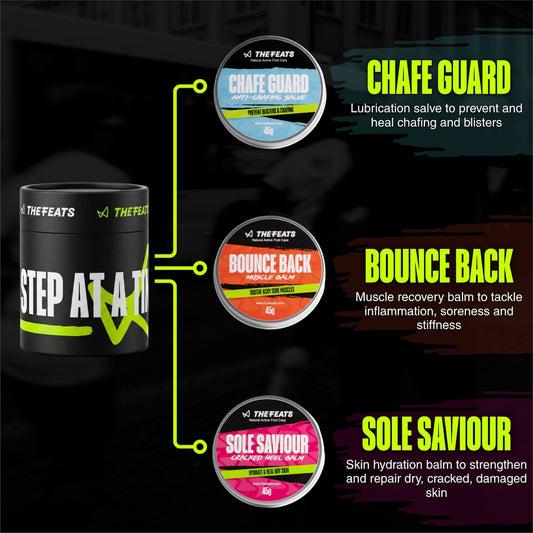
- Resilient skin, not hard skin. This got one of the best questions of the day. Isn't it better to toughen your feet up? Drying your feet out does have some evidence behind it. But hard skin is brittle, and brittle skin cracks under load. A crack in the Sahara is an open door to infection. You want skin that's flexible and resilient — not soft. That's the job we built Sole Saviour for: conditioning the skin daily, for months, so it's in the best possible shape when you fly.
- Get your shoe size right. Feet swell in the heat and over distance. Most people go up at least half a size, often a full size. Test your shoes on back-to-back long days in the heat. Lost toenails are mostly a shoe-fit problem, and no balm fixes a shoe that's too small.
- Trim nails a week or two out. Straight across. Not the night before.
2. In action — keeping healthy feet healthy
You've started healthy. Now protect what you've built.
- Lubricate before your socks go on. Cover known hotspots and anywhere your pack rubs. A good lubricant helps your foot slide rather than grip, so pressure spreads out instead of hammering one spot.
- Know what you're putting on. Petroleum jelly sits on top of the skin and stays tacky, and in the desert, sand sticks to it. Sand stuck to your skin turns into sandpaper. A lipid-based natural balm soaks into the skin rather than sitting on top, leaving a thin, breathable layer. That difference matters over six days.
- Use your checkpoints. Shoes and socks off if you can, sand out, top up your lubricant on any hotspot, give it a couple of minutes to soak in, and go again.
- Gaiters, well fitted. Keep the sand out in the first place.
- Stop for a hotspot. Two minutes now can save the rest of your race.
3. Recovery during the race — the stage after the stage
This is the bit most people underestimate. Your race is decided partly by how you finish each stage. It's also decided by how you START the next one.
Every evening in the bivouac is a chance to get your feet ready for tomorrow. The more comfortably you set off each morning, the more likely you are to reach the finish.
- Shoes off, feet up. Get the weight off and let your feet breathe.
- Clean and check. Get off as much sand and sweat as you can, then check every foot for hotspots, blisters and broken skin. Take anything serious to the race medics — that's what they're there for.
- Ease the soreness. After a big stage your calves, quads and feet are tight and sore, and they have to go again tomorrow. A small balm and a few minutes of massage make a real difference. For us, that's Bounce Back. It contains wintergreen and willow bark, both natural sources of salicylates, the family of compounds that aspirin belongs to. Wintergreen stimulates the nerves in the skin, which masks the deeper ache, so tired legs feel more comfortable.
- Keep the skin supple overnight. A skin balm at night keeps skin flexible for the morning, so it's less likely to crack on day four.
- Carry what you're prone to — and decant. Every gram counts out there. You don't need to carry everything. Know your weak spots, carry what solves them, and decant into smaller pots to save weight. If I could carry only one thing, it'd be a lubricant.
4. Recovery after the race
You've done something extraordinary. Now look after your feet.
- Clean, check and rest. Give broken skin time to recover. Get anything worrying looked at properly — don't just hope for the best.
- Deal with fungus now, not later. Six days in the same shoes is a lot. If anything's come up, get it sorted before it settles in.
- Write down what worked and what failed. That's your plan for next time.
Cheering you all the way
The best part of the day wasn't the panel. It was the conversations at our table.

First-timers. Returners. Everyday athletes taking on the biggest challenge of their lives. Every one of them had a story, a plan, and a little bit of fear. That's how it should be.
Thank you to the MDS team, Walking With The Wounded and Coleman Coaching for having us. And thank you to everyone who stopped to talk feet.
We'll be cheering every one of you from here to the Sahara.
You got this. Go Get It.
— Logan Estop-Hall, Founder, The Feats