Everyone wants the race-day story. The buckle. The finish line. The bit where it hurts and you keep going anyway.
Adrian Ball's story isn't really there.
His story is a spreadsheet pinned to a board in his house. It's a physio appointment every single month, whether anything hurts or not. It's three weekends spent running 80% of a course he'd already paid to race. It's turning down a race he'd trained for because running it would have been stupid.
Then, on 13 June, 100 miles of the South Downs Way in 23 hours, 49 minutes and 30 seconds. At 52.
Ten minutes and thirty seconds inside his target.
The finish was never the hard part. The six months before it were.

Five years ago, he'd done one 5k
Not one 5k that year. One 5k, ever — a fun run, 25-plus years before he ever called himself a runner.
Then, five years ago, he entered a coast-to-coast from Minehead to Dawlish. 110 kilometres over two days. No build-up races. No progression. Straight in.
Since then: 250 kilometres over five days. Multiple 100ks. A pile of 50ks. Twenty-two, maybe twenty-three ultras in five years.
And 2026 is six of them, "because it seemed like a good idea" — the Arc of Attrition 30-miler in January, the Pegasus BOWUM 30 Miler in Wales in April, South Downs Way 100 in June, then the OCC at UTMB in August, Nice in September, Ultra X Madeira in November.
Read that back. Five years. One 5k to twenty-three ultras.
If you're waiting to feel like a runner before you enter something, you've got the order wrong.

The target came before the plan
Last year Adrian ran the South Downs 100k. He went two hours quicker than his previous 100k in Sweden. He loved the route — undulating, spectacular, a proper mix of climbs and views.
So the next step picked itself. Same trail. 100 miles.
Then he did the thing most people skip. He set a number.
The cut-off was 30 hours. Adrian went for under 24.
His reasoning, more or less: he was 52, so why not set himself a really pushy target?
That's the bit worth stealing. Not the distance — the specificity. "Finish" is a hope. "Under 24" is a plan with consequences. It dictates your pacing, your nutrition, your crew, your kit, whether you can afford to sit down at a checkpoint. A soft target gives you nothing to build against.
Pick the number that scares you slightly. Then work backwards.

He built a circle before he built the fitness
Adrian didn't get to 100 miles alone, and he'd be the first to say it. He built a support system, deliberately, over years.
A physio he sees when nothing's wrong. Sam at Get Set Therapy has looked after Adrian since his first running injury. Adrian goes every month without fail — maintenance, not repair. More often when something flares. The value isn't the treatment. It's that Sam knows his body, knows his mileage, and spots things before Adrian feels them.
Strength work, not just running. Dan Hall was Adrian's PT when he started ultra running. Adrian's in Dan's Exeter gym two to three times a week, lifting. He's blunt about it: strength and conditioning was a key part of training for this race. Not a nice-to-have. Not something he'd get to when the running was going well.
A coach to sense-check, not to run his life. Adrian writes his own plans — five years of ultras teaches you your own body. But he took his plan to a well-known ultra coach he met racing Ultra X in Jordan, for one-to-one guidance and a second opinion.
Note what that is. Not outsourcing. Auditing. Adrian owned the plan and got an expert to find the holes in it.
The unglamorous daily stuff. Omega-3. A men's multivitamin. Turmeric for inflammation. Glucosamine for his joints. Collagen in his morning coffee. His own summary: "I rattle."
A crew he chose, not a crew he found. More on that below.
Most people build this circle after the injury. Adrian built it before, and it's the reason he can run four or five days a week — often back-to-back — at 52.

Then he did the least heroic thing possible
His plan went on a spreadsheet. The spreadsheet went on a pinboard at home. He followed it religiously.
There were holidays across those six months. He ran on them, worked the sessions around them, and — this is the part people miss — protected the rest and recuperation too.
There were winter days he didn't want to run. He ran. He's trained in every kind of British weather and every kind of terrain. He practised hills more than anybody reasonably needs to, because he knew exactly what was coming.
No secret session. No magic block. Written down, visible, done.
Consistency isn't the boring prerequisite to the interesting part. Consistency IS the interesting part.
The counter-intuitive bit: his long runs got shorter
Here's where Adrian will annoy you.
Preparing for a 100-mile race, he ran shorter long runs than he used to for a 100k.
That came out of his sessions with his coach. Adrian's logic is simple: the longer the training run, the higher the risk of damage — because when your body's tired and you're pushing, that's when you get hurt. Nothing about a monster training run makes you race-ready if it costs you six weeks.
So he capped his longest efforts at 50 to 60 kilometres. Never further.
Nobody posts about the run they chose not to do. It might be the most important decision in the whole block.

He ran 80% of the course before race day
Over three weekends, Adrian covered roughly 80% of the route he was about to race. Only the early section stayed unseen.
Which meant on race day he wasn't discovering anything. He knew the terrain. He knew where the climbs were. He knew where he could save energy and where he'd have to spend it. He could visualise what was coming and eat before he needed to, not after.
That's not obsessive. That's removing variables.
Uncertainty burns energy — mental energy first, then physical. Every question you've already answered is a question you don't have to answer at hour 19 in the dark.
Nothing on race day was a first time
Adrian's planning for this one was, in his own word, fastidious.
His nutrition was rehearsed, not selected. Highland Fuel Nutrition carb drinks for the stretches where eating was unappealing — and in a 24-hour effort on a hot day, there are plenty of those. Kendal Mint Co gels, because he already knew they didn't upset his stomach, with caffeine held back for the night section when the push was needed. Phoenix Bars for high calorie and carb intake — solid, easy to carry, and founded by James Frost, an Exeter University alumnus. Adrian works at the university, so supporting him was an easy yes.
Precision Fuel & Hydration covered the hydration and sodium side. That's the bit most people get wrong, and it's the bit that decides whether you're still a functioning human at hour 20 on a hot day.
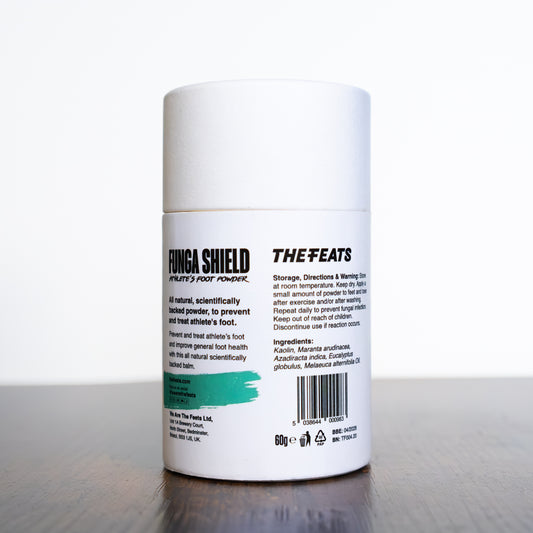
And yes, The Feats had his foot care and muscle recovery covered. More on that in a bit.
He'd practised eating. He'd practised the volume of carbs. He'd worn the kit. He'd prepped his feet.
And then, because this is ultra running and not a laboratory: the odd croissant. Fruit. Ice lollies. Capri Sun — it was a scorcher after all!
That's not the plan breaking down. That's the plan working. When the engineered stuff is rehearsed to the point of automatic, you've got room left for whatever your body actually asks for on the day. Rigid where it counts. Relaxed where it doesn't.
He also learned something from a new top he bought for the recce runs: it rubbed his shoulder and collarbone raw. Which is exactly the sort of thing you want to discover on a training weekend rather than at mile 40.
Test everything in training. Race day is not the place to find out.
Hold that thought. At 60 miles it becomes the whole story.

The race he didn't run
Rewind to the previous November. Madeira. Adrian had trained for it, travelled out for it — and he was injured.
He could probably have started. It was risky. So he didn't.
Sit with that for a second, because it's the hardest thing in this whole story. Not the 100 miles. The bit where you've done the work, you're at the race, and you make the boring, sensible, gut-wrenching call to stand down. He calls it frustrating. He also calls it sensible, and he was right.
So he crewed for other runners instead — 2 days on the checkpoints — and got on like a house on fire with the crew captain, Luis Sparkes. Loo, to everyone who knows him. Adrian went home, messaged him about South Downs Way, and asked if he fancied crewing. Loo said yes inside a minute.
The injury that cost him Madeira is the injury he then took the time to fix properly. Which is how he arrived at the start line of a 100-miler healthy, with a plan, and with people already in place.
Not starting bought him the buckle.

The plan survives contact. The planning doesn't.
Adrian picked his three pacers — Vicky, Fliss and Jess — deliberately. Not whoever was free. People he knows well, chosen for their strengths and matched to the sections they'd cover.
Loo's brief was simple: get Adrian to the finish line smiling, healthy, and inside 24 hours.
Then race day did what race days do.
Within a few hours it was obvious the real race wasn't going to follow the spreadsheet. Adrian was running faster than planned. The temperature climbed past 25°C with barely a breeze. His timings against the plan were, by his own admission, a bit all over the shop.
So from that point on, the crew stopped following the plan and started rebuilding it — live tracker data, aid-station timings, actual mileage, constantly recalculating how much margin was left.
Cooling became a strategy of its own. Chilled bottles ready before Adrian arrived. Ice from the van. Cooling towels. Ice lollies. Hydration and sodium watched closely. Nutrition adapted as the race went on.
He hit 50 miles in just under 11 hours — right where he needed to be.
Then it got tight. By 56 miles the comfortable margin had shrunk to about 45 minutes. Later, to fifteen. The last stretch became a straight race against the clock: roughly 9 minutes per kilometre, no slack, or the sub-24 was gone.
And around 60 miles, solid food stopped going down.
Here's where six months of unglamorous preparation cashed out. Because Adrian had rehearsed his fuelling — practised the gels, practised the volume of carbs, knew exactly what his stomach tolerated — the crew didn't have to force food into a man who couldn't eat. They switched to gels, carb drinks and whatever would actually go down, and he took it all without a single gut problem.
That's not luck. That's a decision he made in February.
By the final aid station the margin was almost nothing. The plan reduced to one line: keep him moving at the required pace. And after 100 miles, the extra distance on top, and a final lap of the track, Adrian didn't scrape home.
He ran the last 2km at a solid pace and sprinted the final 200 metres.
23:49:30. Ten minutes and thirty seconds inside 24 hours. Smiling. Healthy. Buckle earned.
The spreadsheet didn't survive contact with reality. The preparation did — and so did the team. That's the difference, and most people never learn it: you don't prepare so the plan holds. You prepare so you've got options when it doesn't.

Look after your feet and they'll carry you
This is the bit Adrian brought up before we did.
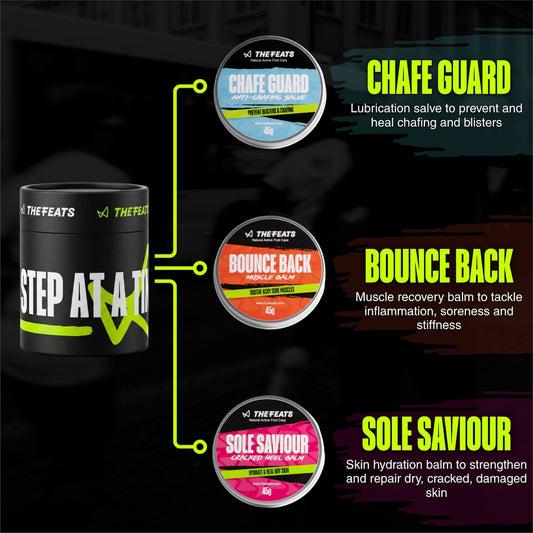
He gets sore muscles — calves and thighs especially. Running four or five days a week, frequently back-to-back, that's the cost of doing business. He uses Bounce Back Muscle Balm regularly through training, and rubbed calves and thighs in the run-up to the race.
He uses Chafe Guard mainly on his feet — and, after the new-top incident, on his collarbone and shoulder too.
We met Adrian at the National Running Show. He tells everyone about the balm now, unprompted, and his reason is the reason we built this company: he knows what's in it. All natural. No horrible chemicals. Healing properties from things that actually grow.
Nothing in Adrian's kit list is there by accident. Including us. That's the standard we want to be held to.
What Adrian would tell you
- Set a number that scares you a bit. "Finish" isn't a plan. "Under 24" is.
- Build your circle before you need it. Monthly physio when nothing hurts. Strength work when the running's going fine.
- Write the plan down and put it where you'll see it. Pinboard, fridge, wall. Then follow it on the days you don't fancy it.
- Shorter long runs. The run that injures you costs more than the run that stretches you gains.
- Recce the route. Every question you answer in advance is energy you don't spend on race day.
- Rehearse the fuel, and the kit. Nothing new on race day. Nothing. It's what saved him at 60 miles.
- Choose your people. Not whoever's available — the right ones, for the right sections.
- Rest is part of the plan, not a failure of it.
- Not starting can be the strong call. Adrian skipped Madeira and it bought him this.
Here's the thing about those ten minutes and thirty seconds. Across 24 hours, that's nothing — it's a slow aid station, one bad patch, one thing you hadn't tested. Adrian didn't find that margin in the last 2km. He banked it in February, in an Exeter gym and on a physio's table and on three recce weekends nobody clapped for.
He's 52, turning 53, and in better shape than he's ever been. Not because of talent. Because he knows his body, and he knows consistency is everything.
He's back in Madeira in November for the race he had to sit out. And he's not done — as he puts it, who knows what else he'll do as a result of this.
You don't need to be gifted. You need a number, a plan on a wall, people who've got you, and the discipline to do the boring bits for six months straight.
That's it. That's the whole secret.
Go Get It, Adrian.