A year ago, Fergus Draper ran his first 10K. It took him an hour and eight minutes and he hated every one of them.
Two weeks ago he crossed a finish line 100 kilometres from where he started, in the pitch black, with 2,200 metres of climbing behind him and forty people screaming at him from the dark.
15 hours and 30 minutes. 44th place. A lot of people didn't finish.
And the first thing he said when it was done was: "I thought I would have gone a bit quicker."
That's the bit worth talking about.

The lie in your pocket
Fergus finished a 100 kilometre ultra marathon ten months after he'd have called the distance impossible — and stood there, legs wrecked, slightly disappointed.
His mate Max, who'd come in at 13 and a half hours, had to spell it out for him. You came 44th. Loads of people didn't make it round at all. You went from 10K to 100K in under a year.
Fergus's own verdict, once the dust settled: "Social media has just made finishing 100 kilometres seem less impressive."
He's right, and it's worth being blunt about why.
What you see on your phone is the top 0.1% of the world, on their best day, edited. Nobody films the training run they bailed on. Nobody posts the one they didn't finish. The advice is all sub-three-hour marathons and cadence and Zone 2, aimed at people whose lives look nothing like yours.
It quietly rewrites your sense of what's hard. And then you do something genuinely remarkable and feel average about it.
So let's be clear. To cover 100 kilometres on foot, in one go, is a feat. To do it inside 24 hours is a feat. To do it in 15 and a half hours, in your first year of running, is exceptional.
Fergus knows it now. It took him a week and a mate to see it.
These are not races
The single most useful thing Fergus learned, he learned on the first climb.
Everyone stopped running. Not some people. Everyone — the whole field, walking up in unison, like someone had blown a whistle.
"I think one thing I learned fairly quickly is not many people run an ultra."
They power hike them. They walk the climbs, jog the flats, and get down the technical stuff without breaking themselves. Fergus came 44th doing exactly that, in what he'd been calling a slow, steady time.
Which reframes the whole thing.
"They're not races. They're events. You can walk the whole thing. Get a pair of poles, hike it fairly quickly, and you'll still do it in about 18 hours. It's not about how long it takes you. It's about: can you do it?"

Nobody at a rest stop is trying to gain places. Nobody's racing past you. People hold gates open. Strangers outside a pub in Brighton shout "yes mate, you've got this" at a man they've never met. Runners already in bits themselves went past Fergus in the final kilometres just to tell him he was nearly there.
It is the least competitive hard thing you will ever do.
The day itself
Up early, at the start for quarter past six, moving by seven. Twenty degrees at its peak, blue sky, properly windy on the tops. The South Downs is exposed and punchy — a serious place to do your first ultra.

The first five kilometres, everyone goes too fast. Adrenaline, crowds, ten months of training landing all at once. God, we're really doing this.
Then the first climb, and the whistle nobody blew.
25K. Rhythm found, music on, feeling good. Crew take his empty flasks, hand them back full, and start asking the right questions. What have you eaten? Just gels? Have this bar. Take that. How are the socks?

38 to 42K. The wall. He'd run 40K three times in training and it had never felt like this. Groin went a bit. Sixty kilometres still to go — one and a half marathons — and the maths is the enemy.
This is where he made the decision that got him home. He'd wanted midnight, a 17-hour finish. He binned the target.
"Do you know what, I'll finish when I finish."
It got easier immediately. Not physically. Mentally. Stop worrying about whether your mates are still waiting at the end. Worry about yourself.

The run into Brighton. Long, slow downhill, sun out, music in, strangers cheering. He describes it as the best stretch of the day.
Brighton itself. Horrific. Two kilometres of seafront dodging tourists and bikes, then a kilometre of road up to Hove Park with traffic lights every hundred metres. Rhythm is everything in an ultra, and a red light every sixty seconds destroys it.
57K, halfway checkpoint. Without the two blokes crewing him, Fergus says flatly, he'd have packed it in. Instead: lie down, legs up, socks in the bin, fresh pair on, chafe cream reapplied, real food — chicken nuggets and chips, of all things — plain water rather than more electrolyte, a stretch, more muscle balm. Then the line that did the work: you're only half an hour behind Max.
From there on there was no version of this where he stopped. Only a version where he slowed down. Which was fine.
70K. He took a full five minutes. Deliberately. Ate proper food instead of another gel. First painkillers. Stretched it out.
"I've got no doubt that taking an extra five minutes at an aid station, in the state I was in, saved me half an hour down the line."
82K, last crewed point. Right knee sore on the outside. Shins going. The steep rocky descents were down to a 17-minute-kilometre walk, because running them would have ended it.
The last 18K. Nine-and-a-half-minute kilometres instead of eight. Walk every uphill, no argument. Jog what you can. It isn't a race.
His watch was a couple of kilometres ahead of the course markers, so the 100K sign arrived and he'd actually covered 103. Pitch black. No finish line. Nothing.
Half a kilometre round the corner: forty people, shouting.
"If I'd had anything left to give, I probably would have burst into tears at the finish line. But I'd certainly done enough."

Solving problems at 80 kilometres
Here's the part that doesn't fit on a training plan.
Anyone can do the sessions. Anyone can build up to 40K. What nobody can rehearse is what you do when your right knee starts screaming at hour eleven.
Fergus's answer was to treat it as a problem, not a verdict.
Could he tape the knee? No — legs too hairy and too sweaty, the tape wouldn't hold. Could he change his running style to take the load off it and reduce the impact through the leg? Yes, as it turned out. Loosen the shoes here. Tighten them there. Walk that hill and stop pretending otherwise.
"You've got to think on your feet. You've got to find a problem and solve it when you're out there."
That's the actual skill in an ultra. Not suffering (well a little). but Adapting.
Look after your feet and they'll carry you
103 kilometres. Fifteen and a half hours. Twenty degrees. One sock change.
Not a single blister.
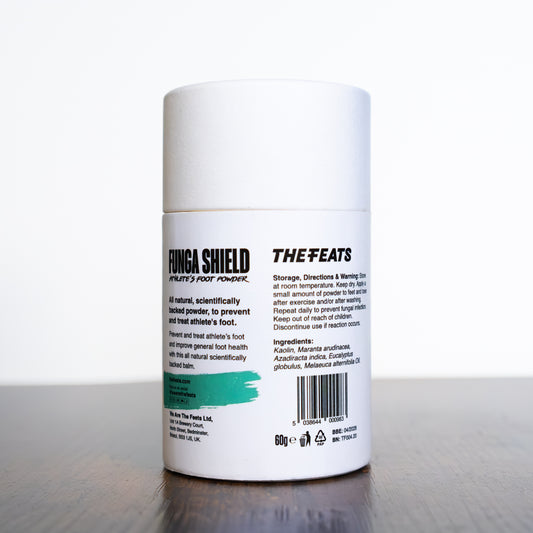
This is the bit Fergus led with when he called us, and he was almost indignant about it: "Blisters? Not an issue, mate."
What he actually did:
-
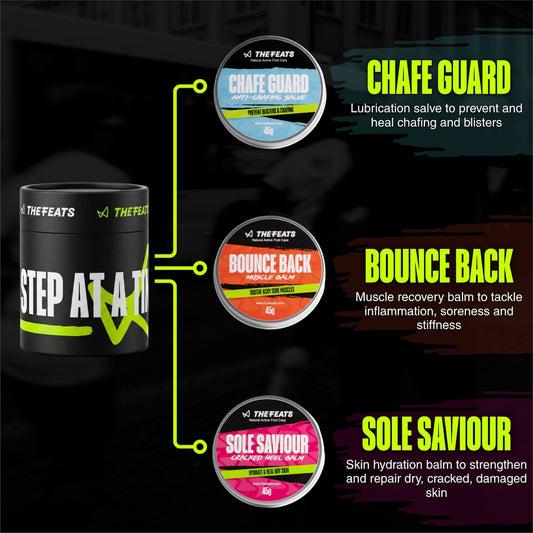
Chafe Guard everywhere that needed it, before the start. Feet, and everywhere else a long day rubs. He reapplied on his feet once, at the sock change around 57K. Nowhere else, all day.
- The result: no blisters, no red patches — not on his legs, not anywhere. "Feet are looking remarkably good." At the halfway checkpoint his crew inspected them, expected carnage, and found none.
- Bounce Back Muscle Balm was, in his words, an absolute game changer. On the groin when it tweaked at 40K. On the calves when they started burning. Again at 70K. "It really did help massively."
- Sole Saviour since. Because the recovery is part of it too, and feet that have done 103 kilometres have earned it.
The one thing he'd change had nothing to do with his fitness. His heart rate was superb. His fuelling — the thing that ends most ultras — he got right. The legs were there.
It was his socks. Ankle socks, and the physio's ultrasound afterwards found an angry sheath around a tendon in his left foot: friction and restriction, right where a low sock cuts across. Longer socks next time, and the shin pain that made the last 18K a grind probably doesn't happen.
A hundred kilometres, and the limiting factor was two inches of fabric.
That's the whole argument for preventative foot care in one sentence. The fitness is the hard-won part. The thing that actually stops you is almost always small, boring, and preventable that morning.
What Fergus would tell you
- Put the phone down. You're comparing your first year to the best day of the best 0.1%. Finishing is the achievement. Full stop.
- It's an event, not a race. Walk the climbs. Everyone else does. Poles and a hike will still get you round.
- Bin the target if it's costing you. "I'll finish when I finish" is what unlocked the back half.
- Take the extra five minutes. Five at a rest stop buys you thirty later.
- Eat real food. Gels alone will shut your stomach down. Chicken nuggets and chips at 57K is a legitimate strategy.
- Get a crew. Not optional. They ask the questions you're too tired to ask yourself.
- Test your socks. And your kit, and your fuel. The thing that hurts is never the thing you feared.
- Solve, don't suffer. Tape it, loosen it, change your gait, walk it. There's always a lever.
Why he was out there
None of this is really about running.
Twenty years ago Fergus lost a school friend, James Wentworth-Stanley, to suicide. James's family founded James' Place, which gives free, life-saving therapy to men in suicidal crisis. Last summer he lost another friend, Ned, home from fighting in Ukraine. In March, a university friend. Out of the blue.
Suicide is still the biggest killer of men under 50 in this country. Still preventable. Still happening.
So Fergus went and found something remarkable enough to be worth the ask.
He's closing in on £16,000, with more still to come. By James' Place's own measure, that's eight men in crisis who get the help that his friends didn't.
"So all this slightly sore legs has completely been worth it."
Eight men. Fifteen and a half hours. One bloke who a year ago couldn't stand running.
Would he do it again?
At the time? Absolutely not. A few weeks off, a fat left ankle, and no desire whatsoever to go near that kind of training block again.
Now? "Never say never. We'll cross that bridge when we come to it."
We've heard that one before.
Here's what we'd say to anyone reading this from the sofa, wondering whether the version of you that does something like this exists.
Twelve months ago Fergus Draper was an hour and eight minutes round a brewery 10K, absolutely knackered, wondering why anyone bothers. He didn't get faster first. He didn't get fitter first. He found a reason that mattered more than his comfort, went out for an hour most days, looked after the small stuff, and let the rest follow.
That's an everyday champion. That's the whole thing.
15:30. 103 kilometres. 44th. Nearly £21,000. 10 men saved.
Not bad for someone who was never a runner.
Go Get It, Fergus.
Fergus is fundraising for James' Place, which provides free, life-saving therapy to men in suicidal crisis. You can sponsor him via Just Giving here.
If you or someone you know is struggling, you don't have to face it alone. In the UK you can call Samaritans free on 116 123, or text SHOUT to 85258, 24/7.