A Newcastle coach who once blistered on every run is now grinding out 116-mile backyard ultras through the night. This is Jack Curtis's story — the showing up, the setbacks, and the small details that add up to something big.
It's somewhere past the 28th hour. Cheltenham. Jack Curtis has already run further than most people will in a year of training — 116 miles, lap after identical lap, through a full night and into a second day. He's 14th out of 300 starters. Two more laps and he's in the top ten. And then his hip gives out. A stabbing pain, no run left in it, and a race that ends not because his mind quit but because his body finally reached a place it had never been.
Most people would call that a bad day. Jack calls it homework. "It got under my skin, that one," he says. "I'm going back next year to beat it."
That, in a sentence, is who Jack Curtis is.

The everyday athlete
Jack isn't a professional runner. He's a personal trainer from Newcastle, working both online and out of Storm Fitness, who coaches ordinary people to get stronger and fitter. He's been there himself — an overweight teenager who learned, the hard way, what it takes to change. That's the coach his clients get: someone who meets you where you are and shows you the path forward, because he's walked it.
Away from the gym floor, Jack is chasing something few people ever attempt. The backyard ultra is one of the cruellest formats in the sport: run a 4.167-mile loop, every hour, on the hour, for as long as you can. Finish the loop, rest what's left of the hour, go again. There's no finish line — only the moment you can't start another lap. It rewards patience, discipline, and a stubbornness that borders on daft.
It suits him perfectly.

Learning what the miles demand
The last twelve months have been an education. At the Pilgrim 100k, Jack finished second — a podium earned through seven straight hours of biblical rain, feet soaked, head down. Then a backyard ultra in Morpeth: 112 miles, joint fourth, twenty-seven hours on hilly trail.
What comes through, listening to Jack talk about these races, is how much of ultra running is unglamorous problem-solving. At Morpeth he ran sixteen hours in wet socks before he even clocked it — "I touched the bottom of my socks and went, oh, these have been wet for sixteen hours." He picked up a couple of blisters for it and took the lesson square on the chin: change your socks, stay on top of the admin, respect the small stuff. No excuses, just data for next time.
Because that's the thing about competing at these distances — it's rarely the heroic moments that make or break you. It's the sock changes at 3am. The chafing you didn't prevent. The nutrition you skipped one lap too many. The blister that becomes a limp that becomes a DNF.
The winners are the ones who obsess over the boring details until the boring details stop being the reason they stop.

The hardest race of his life
Five weeks after Morpeth, Jack lined up at Cheltenham RedOn on legs that still carried the fatigue of 112 miles. It was, by his own account, the hardest thing he's ever done. His legs were hurting from 30k in. He dug through the dark, lap after lap, and when the sun came up he felt reborn — "when that sunrise hit I was just good to go, mentally I was there till the next morning." His body had other ideas. The hip went. The race ended at 116 miles.
Here's what tells you everything about where Jack is headed: he wasn't beaten by the distance, or the night, or his own head. He was beaten by one specific, fixable thing — and he's already turned it into a training problem to solve. "It was a real eye-opener for how I need to physically prepare better if I want to run further. Mentally I was there. I just need my body to catch up."

The details that free him up
When you strip a runner's problems back one by one, you find out what they're really made of. Jack has spent a year methodically removing the things that used to stop him — and one of the biggest was his feet.
It's easy to forget now, but Jack used to be "the runner who got blisters every single time I went out." He'd tape up before every long run and blister anyway. For a man who wants to run 200-plus miles in a sitting, feet that fell apart on a training loop were a hard ceiling.
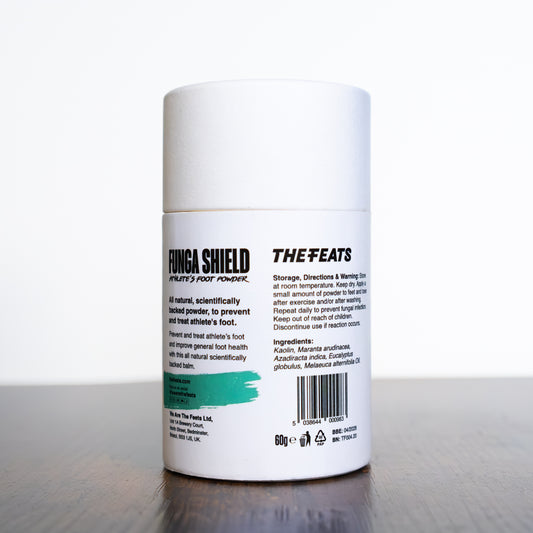
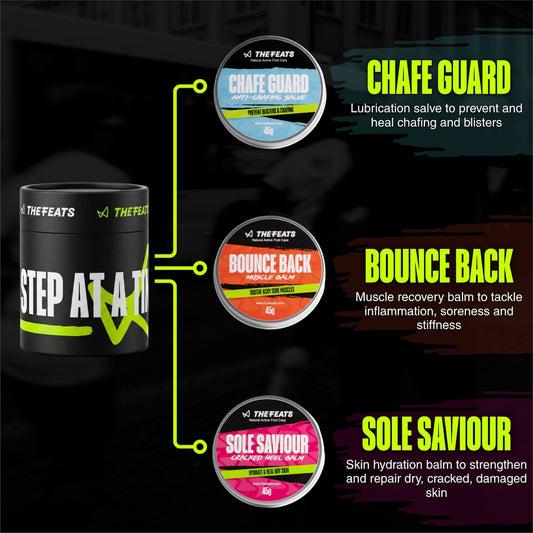
That ceiling is gone. Somewhere in the mix of his kit, his nutrition, his sock discipline and his recovery sits a simple foot care routine that's become non-negotiable — Soul Saviour to prep and recover, Chafe Guard to hold off friction, Muscle Balm to bring his legs back afterwards. Across a podium 100k in the rain, 112 miles at Maupath and 116 at Cheltenham, his feet have quietly stopped being part of the conversation. "Me getting a blister now is weird," he says. Which is rather the point — the best support is the kind you stop noticing.
We're proud to play a small part in that. Jack's the one putting in the miles; we just look after his feet so he can get on with the feat. It's his name on the result. We're glad to be one of the boring, essential details in the background.
The big dream
Jack isn't collecting finish lines for the sake of it. Everything is building towards one audacious goal: a qualifying total for the GB backyard ultra team. In practice that means running well past 50 laps — comfortably over 200 miles, last person standing. "It's very lofty. Very ambitious. But it's the only big goal in my diary for the next twelve months, and every race is building towards it."
Before then there's the Kielder Marathon in October, the Cheviot Goat — a brutal 94k — in December, and a return to Cheltenham to settle the score with that hip. One block at a time. One boring detail at a time.
He's a coach who knows there are no shortcuts, an everyday athlete who keeps showing up, and a Big Dreamer with a number in his head that most people would call impossible. Our money's on him getting there.
Go get it, Jack.
Follow Jack's journey on Instagram @jc_performancecoaching or Youtube @JC_Performancecoaching. Race photography by canny candid.