Fergus hated running.
Not "wasn't very good at it" hated. Properly hated it. Cross country at school — no thanks. The long stuff — never. He liked short distances, the odd sprint, and that was that.
His first real run came in lockdown, 2020. The Run 5, Donate 5, Nominate 5 thing. He knocked out a couple of 5Ks somewhere between 30 and 40 minutes, stopping to catch his breath, not enjoying a second of it. Then he moved to the country, bought a £25 pair of trainers off the internet, and did the occasional plod. Still not fun. Last year a mate talked him into a brewery 10K — run 10K, sink a pint at the end. An hour and eight minutes. Horrible. Absolutely knackered.

"No seasoned runner at all," as he puts it.
This September, Fergus is running a 100 kilometre ultra marathon across the South Downs. 2,500 metres of climbing. A distance he'd have called impossible not so long ago.
This is how he got there.
The why comes first
Fergus didn't wake up one day wanting to run further. He found a reason to.
Twenty years ago, a best mate from school, James Wentworth-Stanley, took his life — back before men's mental health was something anyone talked about. James's family went on to found James' Place, a charity offering free, life-saving therapy to men in suicidal crisis. Last summer, another close friend — Ned — came home after fighting in Ukraine, lost his sense of purpose, and took his life too. In March this year, a university friend did the same. Out of the blue.
Suicide remains the single biggest killer of men under 50 in this country. Preventable, and still happening.
So Fergus decided to do something that actually meant something. Not a marathon — "that's so last year," he says, half-joking. It had to be a feat remarkable enough to be worth the ask. He signed up for the 100K, picked James' Place, and started training.
Every time he doesn't fancy a run, he thinks of the men out there in crisis. Whatever he's going through on a jog round the park, they're going through worse. That's the engine. The mileage is just what it drives.
Time on feet, not distance
Here's the piece of advice that changed everything — and it's almost nothing.
Stop counting kilometres. Count time on feet.
Fergus used to fixate on a "nice little 5K loop." The advice he got: don't. Don't worry about length. Just go out for an hour. He's got Bucklebury Woods near home — tens of kilometres of trails through the estate that he now knows like the back of his hand. He still calls his runs 5K, 10K, 20K out of habit, but really he knows a route is "an hour" or "two hours," and that's what he trains.

The routine built itself from there:
- One hour, most days — 8am, midday, or an evening run now the weather's warmer.
- One big run a week.
- Trails over concrete wherever possible. (His verdict on Battersea Park: "more of a catwalk with the latest fashion" than a run.)
From the odd reluctant plod, Fergus is now closing in on 130 hours of running this year (totalling more than 1,250 kms). Two weekends ago he finished his first trail marathon, the Hampshire Hoppit, in around five hours — including a penultimate kilometre with a 91-metre climb and a 27.5% gradient that he has some choice words about.
The difference now? He actually enjoys it.
A one, two, three-hour run is thinking time. Space to rehearse a difficult conversation ten times until you get it right. Or headphones in, podcast on. Or nothing at all — just the sound of the woods. Consistency didn't come from willpower. It came from routine, a reason, and finding out that the running itself was the reward.

Look after your feet and they'll carry you
Everyone told Fergus his knees would go. They haven't. His answer is simple: get the right gear, and prevent problems before they start.
"Prevention is definitely better than the cure." He learned it the hard way — one cold, wet 5K in a t-shirt left him sore for days. Chafing. Now a little Chafe Guard goes on before every run, and after a trail marathon in 28-degree heat, everywhere he applied it came through completely fine.
His kit for going long, and staying uninjured:
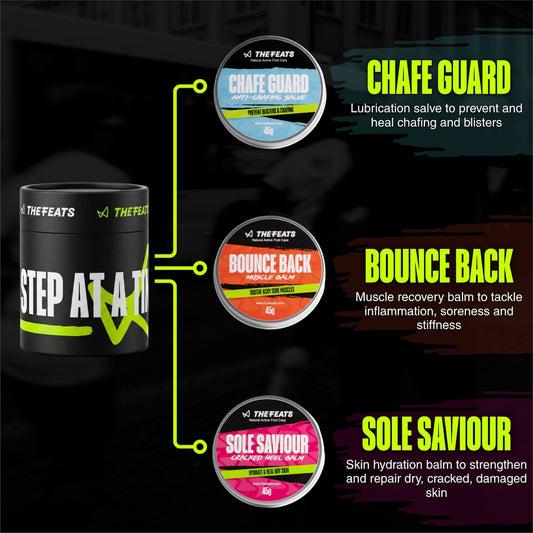
- Chafe Guard before every run. Come rain or shine. No Vaseline anywhere in the house.
- Bounce Back Muscle Balm after long runs — anything over 15-20K. A little on the quads before back-to-back runs, too. (Nobody warns you the quads scream louder than the calves after a downhill.)
- Sole Saviour to keep the feet in good nick. Proper socks, proper shoes, and healthy skin — that's how you avoid the blister that ends your race.
- Hydration vest, electrolytes when it's hot, and — the bit he got wrong for months — eat enough. Heavy legs early on turned out to be under-fuelling. Half a kilo of pasta in a day sorted that.
The theme runs through all of it. The last thing you need mid-race is a blister or a chafe injury you could have prevented that morning. Look after the small stuff and it looks after you.
What Fergus would tell you
If you're where he was — no running, no desire, no ability — here's what he'd say.
Find a purpose. His was a 100K for a cause he couldn't ignore. Yours can be anything that gets you off your backside.
Forget the noise. Ignore the Instagram accounts telling you your cadence must be 180 or you must live in Zone 2. Most of his training is easy, conversational, endurance pace. His Zone 2 might be 120 or 150 — it's individual. Don't go chasing heartbeats. Just ask: could I hold a conversation right now? (He sometimes rings his brother in Hong Kong mid-run to check.)
And it does not matter if your 5K takes 15 minutes or an hour. It doesn't matter if the ultra takes five hours or ten. Time on feet. That's the whole game.
The proof is in Fergus himself. Lightest and healthiest he's been since school. Sleeping well. Better mood. Knees fine. And in September, he'll cross a finish line he once thought was beyond him — with his kids watching, proud.
That's an everyday athlete. Someone who wasn't built for this, decided it mattered, and built the routine anyway.
You don't need to be a runner to start running. You just need a reason and an hour.
Go get it.
Fergus is fundraising for James' Place, which provides free, life-saving therapy to men in suicidal crisis.
If you or someone you know is struggling, you don't have to face it alone. In the UK you can call Samaritans free on 116 123, or text SHOUT to 85258, 24/7.